

- This event has passed.
[TRAINING] Transportation Equity: Developing Solutions for Social Inclusion – Nov 2025
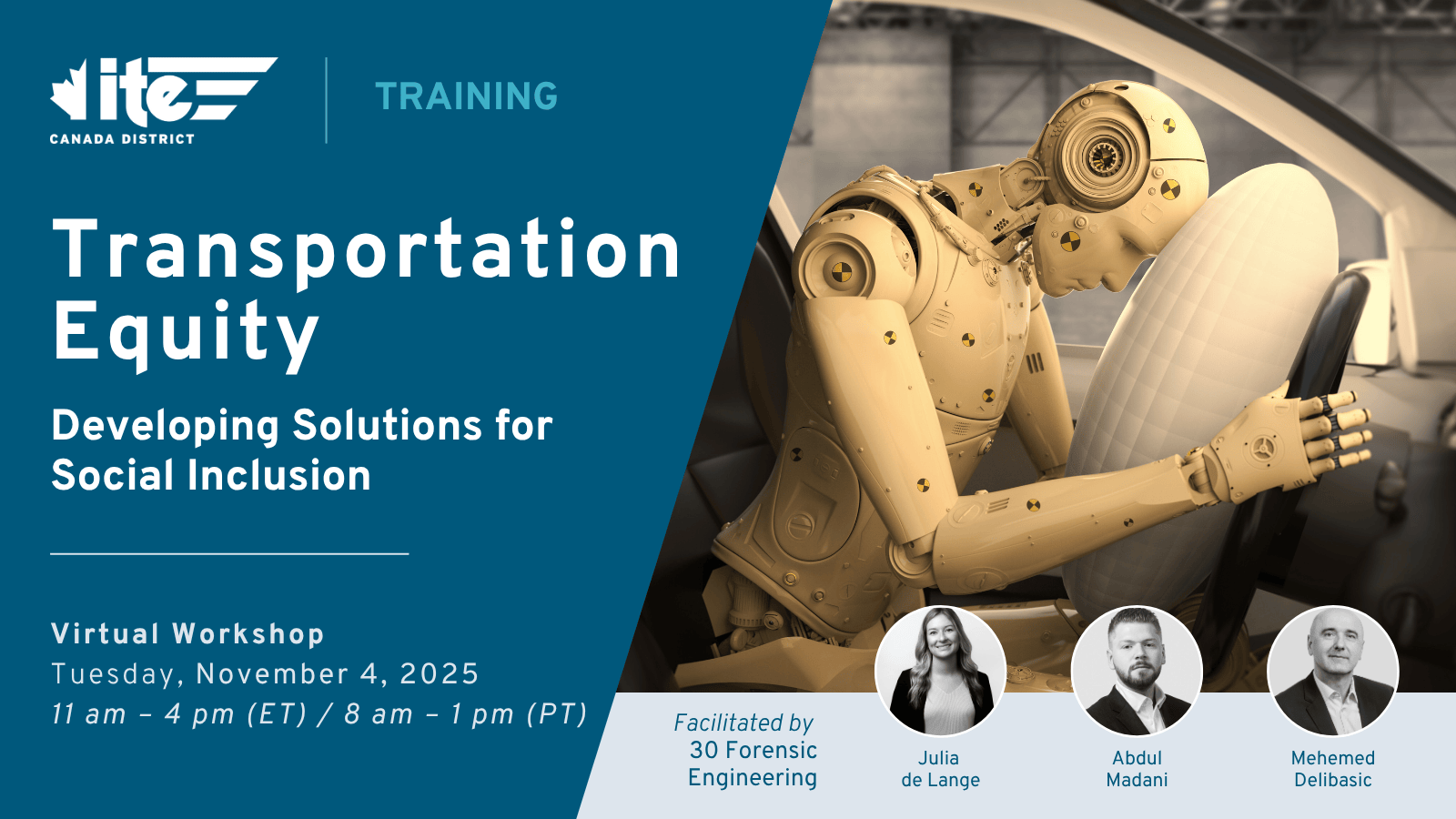
Date: Tuesday, November 4, 2025
Time: 11 am to 4 pm (Eastern Time) / 8 am to 1 pm (Pacific Time)
Location: Virtual workshop. Meeting link will be provided in registration confirmation email.
This session will qualify for PDH credits for attendees.
Workshop Description
Transportation systems shape access to opportunities, yet mobility inequalities persist. Social exclusion in mobility is not a new issue, but systematic inclusion principles and processes remain limited, and the knowledge in this area is yet to be fully developed. This training course seeks to help transportation professionals understand how changes to transportation systems can be more socially inclusive and address issues of inequality.
Supported by internal research and developed by a diverse team of experts, this workshop combines strong theoretical foundations with practical applications to offer a comprehensive approach to transportation equity. Participants will learn how transportation equity principles, tools, and solutions translate into real action and change the course of transportation infrastructure programs and delivery. The goal is to equip transportation practitioners with the tools to create more inclusive, resilient, and just mobility systems.
Participants will gain practical strategies and real-world insights to apply transportation equity principles in their daily work. Through case studies and expert guidance, they will learn how to turn equity concepts into actionable solutions that shape inclusive policies, programs, and infrastructure. This course will provide alternative perspectives to align transportation policies, programs and implementation with the Canadian National Human Rights Charter, treating equity as a fundamental right, not just as an additional consideration. Training content highlights systemic exclusion, its impact on marginalized communities, and strategies to mitigate unintended consequences and address equity gaps. By integrating well-established and emerging transportation equity concepts into practical applications, the course equips participants with the knowledge to embed equity into everyday transportation practices and decisions.
The half-day course is divided into several sections:
- Basics of Transportation Equity: The workshop will start with fundamentals of transportation equity, basic principles, history, theoretical foundations such as framework and types of transportation equity, philosophical framework, systematic causes of inequality, spatial justice theories and other fundamentals. It will include participant interactions and quick surveys.
- Equity in Public Space: This topic will delve into spatial injustice, recognize recurring inequality conditions, and address them through an equitable approach to public street design and placemaking concepts, using unused space identification, redesign, and implementation strategies.
- Equity and Mobility Resilience: Understand the resilience of transportation systems in the face of climate change disparities, energy depletion, and environmental viewpoints, including new approaches to mobility energy planning and policy development.
- Equity in Emerging Mobility Modes and Technologies: Examine the promises and challenges of new mobility technologies and apply solutions to prevent emerging inequalities in digital and shared mobility platforms.
- Equity in Mobility Access Planning and Policy: Explore new concepts, solutions, and practical tools for multimodal planning and design, including the creation of multimodal mobility hubs to improve access to diverse transportation modes.
- Transportation Disadvantage and Poverty: Discover strategies and tools to combat transportation poverty and mobility disadvantages and explore how overlooked indicators and data can contribute to systemic inequality.
- Design Parameter and Equity Connections: This session will uncover hidden gender disparities in automobile design and their links to road safety inequalities and learn processes to reduce and eliminate these disparities. In addition, participants will gain insights from real-life safety incidents and collisions and understand how transportation equity plays a crucial role in fostering inclusion, upholding human rights, and providing liability and judicial perspectives.
- In Class Exercises: Through interactive exercises and digital tools, participants will examine how shared mobility solutions can complement existing transportation policies to close equity gaps. These activities will highlight strategies for integrating equity considerations into planning and decision-making, with a focus on systemic inclusion and spatial justice.
Target Audience
Transportation engineers, planners, land use planners, urban designers, mobility technology service providers, and other professionals involved in urban mobility system development, who are focused on promoting equity within sustainable mobility solutions.
Learning Outcomes
As a result of attending the training, practitioners will be able to:
- Evaluate the processes used to implement equity policies and laws in contemporary transportation practice
- Identify the equity concerns associated with various tools for evaluating travel patterns and behavior
- Apply strategies and tools to increase the access to employment, education, affordable housing, and transportation for under-served communities
- Evaluate various strategies designed to increase access to emerging modes for under-served populations
- Identify the potential equity impacts of proposed transportation funding mechanisms
Trainers
Instructors: Julia de Lange, PhD, P.Eng.; Abdul Madani, M.Eng, EIT; and Mehemed Delibasic, P.Eng.
Support: Abdul Razak Alozi, PhD, EIT; Maryam Hasanpour, PhD, EIT
Julia de Lange, B.Eng., M.A.Sc., Ph.D., E.I.T.
Dr. Julia de Lange is an Associate with the Biomechanics and Personal Injury group at 30 Forensic Engineering. She earned her M.A.Sc. and Ph.D. in Biomedical Engineering at McMaster University after completing her undergraduate degree in Biomedical Engineering at the University of Guelph. Her research focused on developing enhanced injury tolerance criteria for automotive and defense applications, and appropriately translating these to crash test dummies. She has taught undergraduate courses in Biomedical Engineering and Mechanical Engineering at McMaster University.
Abdul Madani, BSCE, M.Eng., E.I.T.
Mr. Abdul Madani is an Associate with the Transportation and Safety Group at 30 Forensic Engineering. He graduated from the University of Sharjah with Bachelor of Science in Civil Engineering and a Master of Engineering in Civil Engineering from McMaster University, with a specialization in geometric design risk and reliability assessment and highway safety. Prior to joining 30 Forensic Engineering, Abdul worked for the Transportation sector in the Government of Dubai where he gained a range of skills in traffic safety, work zone safety and traffic management, road users’ safety, policy updates, and Vision Zero projects.c
Mehemed Delibasic, B.Sc., M.Sc., P.Eng.
Mehemed is Vice President of the Transportation and Safety Group at 30 Forensic Engineering. With over 25 years of comprehensive professional experience, Mehemed has been involved in and managed numerous multi-modal transportation planning studies, transportation master plans, and transportation planning/traffic engineering studies. His most recent experience applies an equitable approach for Transportation/Active Master Planning Studies, including affordable and equitable accessible transportation options. Mehemed is a recognized subject matter expert on the latest multi-modal transportation master planning studies, active transportation master plan studies, parking, and traffic safety, and has delivered several presentations on these topics at industry events.
Registration deadline: Monday, November 3, 2025 at 12 noon ET