

- This event has passed.
[TRAINING] Geometric Design: Fundamentals and Emerging Practices in Urban Street Design – Feb 2026
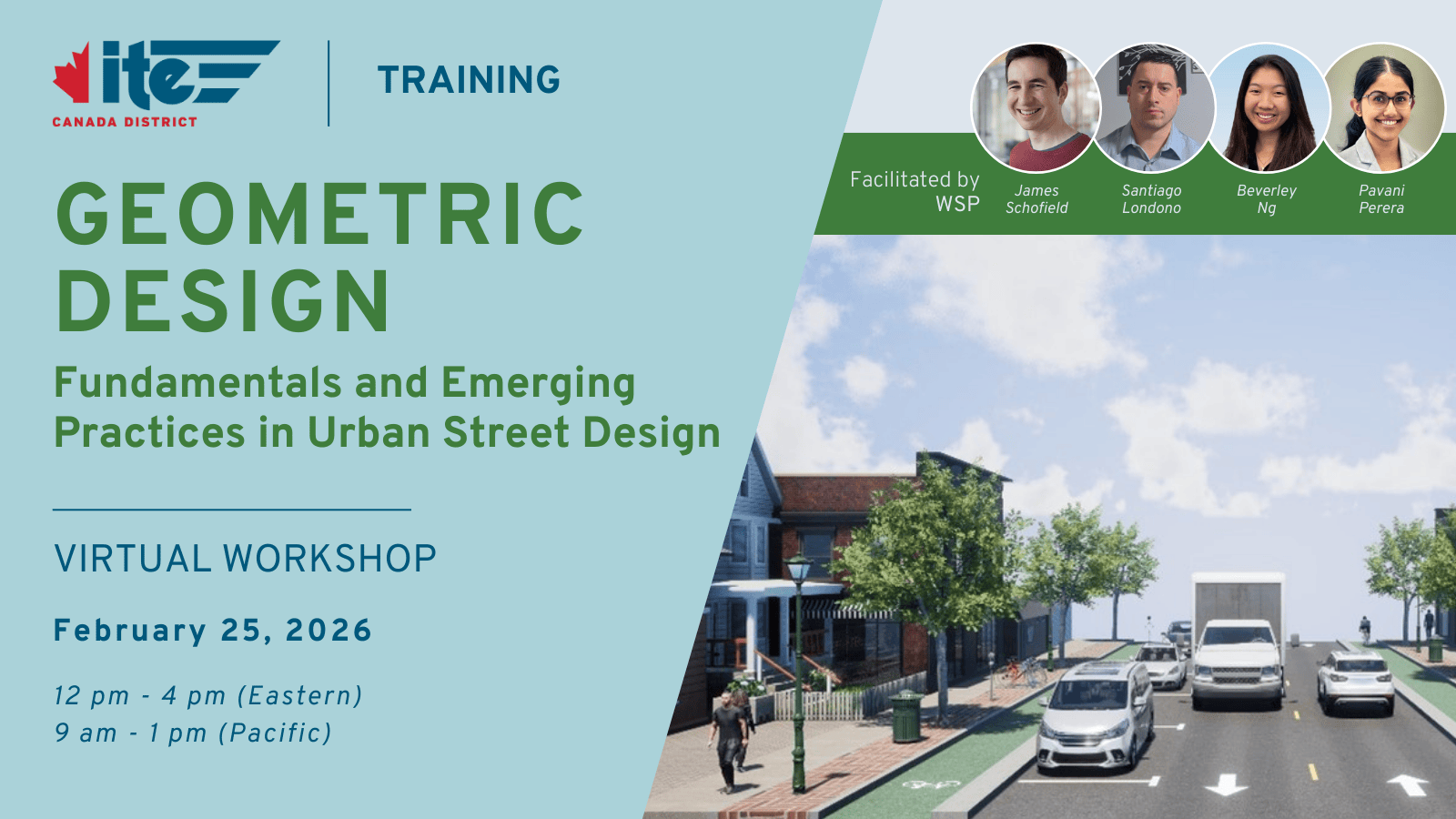
Date: Wednesday, February 25, 2026
Time: 12:00 – 4:00 pm ET / 9:00 am – 1:00 pm PT
Location: Virtual.
This session will qualify for PDH credits for attendees.
Urban streets are more than conduits for traffic—they are complex environments that support movement and serve as vibrant places for community connection and economic activity. Designing these streets requires balancing safety, mobility, and livability while accommodating diverse users such as pedestrians, cyclists, transit riders, and goods movement.
In the past decade, there has been considerable evolution in design practices for Canadian urban streets by shifting away from minimum design standards towards a more nuanced, context-specific “design domain” approach. This evolution requires practitioners to apply greater engineering judgment and consider a broader range of factors and user perspectives.
This training equips participants with the knowledge and tools to navigate this evolving landscape with live facilitators that offer a variety of experience in planning and designing for complex urban environments, including complete streets and protected intersections. A mix of presentations, case studies, interactive exercises, and question and answer periods will be incorporated to allow attendees to apply fundamental design principles for urban streets, navigate design trade-offs, and incorporate emerging solutions.
This training will be organized as follows:
- Introduction to Urban Street Design: The session will begin by examining the functions of urban streets for varying users and their role in supporting access, mobility, and placemaking. We will introduce the design domain approach, contrasting it with traditional minimum standards and emphasizing the role of engineering judgment. We will then shift to concepts related to design controls and emerging solutions for speed management, including self-enforcing streets, highlighting how geometric design influences user behaviour and safety through Exercise #1.
- Urban Street Cross-sections: Next, we will examine key urban street elements and how to select appropriate widths within the design domain and make trade-offs for varying contexts and user needs. Participants will then apply these concepts in Exercise #2 using real-world case studies and interactive tools that will challenge them to redesign urban streets to meet specified priorities within constrained rights-of-way and understand the equity implications of design decisions.
- Horizontal and Vertical Alignment for Urban Streets: This part of the training will explore fundamental concepts on horizontal and vertical alignments of urban streets and strategies to incorporate considerations for drainage, safety, and sight distances. Real-world case studies will be used to illustrate the connections between design controls and speed management to horizontal and vertical alignment design choices.
- Urban Intersection Design: The final block will focus on key principles of urban intersection design, including control types, user safety considerations, and design/control vehicle selection. We will also provide a high-level overview of emerging concepts like protected intersections and multimodal roundabouts. To reinforce learning, Exercise #3 will be conducted, each with a facilitator that will guide participants to sketch geometric features of different intersection types. We will wrap up with a summary of key takeaways and an opportunity for participants to reflect on how to apply these concepts in their own practice.
LEARNING OUTCOMES
As a result of attending this training, participants will be able to:
- Describe the key functions and elements of urban streets, including the roles of access, mobility, placemaking, and the needs of multi-modal users
- Differentiate between traditional minimum standards and the “design domain” approach in geometric design and explain the importance of engineering judgment in selecting design parameters
- Understand speed management, self-enforcing roadway concepts, and the relationship between design features and operating speeds
- Analyze and conceptually design cross-sections for urban streets, balancing competing demands within constrained rights-of-way
- Evaluate horizontal and vertical alignment elements for safety and operational effectiveness in urban contexts
- Assess intersection control types and geometric design considerations, including impacts of design/control vehicle selection and corner radius
- Collaborate in group exercises to solve real-world design challenges, using interactive tools to reinforce learning through practical application
- Interpret case studies to connect theoretical concepts with built examples, strengthening the ability to apply best practice to local projects
AUDIENCE
Technical guidance on designing urban streets is important to the day-to-day practice of a variety of professionals in transportation and related fields to ensure that their work reflects the changing needs of their local communities. Therefore, this training program is valuable for a range of practitioners involved in the implementation and management of public streets, including new road designers looking for a high-level overview of urban road geometric design, experienced professionals looking to stay abreast of latest best practices, and everyone in between. This may include transportation planners, technologists, engineers, landscape architects, and others involved in the planning, design, and operation of urban streets.
FACILITATORS
James Schofield, P.Eng., RPP, RSP2I
Lead Trainer
James holds a Bachelor of Applied Science in Computer Engineering and a Master of Planning in Urban Development, bringing over 18 years of engineering experience, including 7 years in the transportation field. He specializes in active transportation, complete streets, and road safety projects ranging from developing design guidelines, master planning, feasibility studies, environmental assessments, and preliminary/detailed design. He led the development of award-winning design guidance, including the Ontario Protected Intersection Guide and the Hamilton Complete Streets Design Manual. Also, he was a lead trainer for numerous in-person and virtual training programs for the Ontario Traffic Council (OTM Book 18: Cycling Facilities and Ontario Protected Intersection Guide) and the City of Hamilton (Hamilton Complete Streets Design Manual). James sits on TAC’s Active Transportation Integrated Committee and is ITE Canada’s representative on the ITE Pedestrian and Bicycle Committee.
Santiago Londono, P.Eng., PMP
Lead Trainer
Santiago holds an Ontario College Advanced Diploma and a Bachelor’s Degree in Civil Engineering, bringing over 10 years of experience in construction and municipal infrastructure projects. He has led the preliminary and detailed design of local, collector, and arterial road reconstruction projects, with expertise in road geometry, widening and narrowing strategies, and sightline analysis. Santiago’s work emphasizes delivering safe, efficient, and sustainable transportation solutions.
Beverley Ng, BASc., EIT
Assistant Trainer
Beverley holds a Bachelor of Applied Science in Civil Engineering, bringing over 3 years of experience in transportation planning and engineering. She was a lead author on the TAC Lower Speeds on Collectors and Arterial Roads: Synthesis of Practice, pulling together lessons learned from literature and from municipalities across Canada in various contexts. Beverley was also an onsite researcher for transit infrastructure for people with sight loss, has collaborated on active mode and streetscaping projects, and continues to work on traffic and transit operations.
Pavani Perera, P.Eng.
Assistant Trainer
Pavani holds a Bachelor of Applied Science in Civil Engineering, bringing over 5 years of experience in transportation planning and engineering. She has contributed as a technical analyst and coordinator to various projects primarily focused on vulnerable road users, including active transportation master plans, active transportation preliminary designs, complete street guidelines, vulnerable road user safety assessments, feasibility studies, environmental assessments, and transportation impact studies. Also, she was an assistant trainer for numerous virtual training programs for the Ontario Traffic Council (OTM Book 18: Cycling Facilities and Ontario Protected Intersection Guide) over the past two years.
REGISTRATION
Deadline: Registration will close on Tuesday, February 24, 2026 at 12 noon ET
NEW! Group Discount: Receive a 15% discount on 3 or more ITE Member ($275) and/or Non-Member ($400) registrations purchased in the same transaction. Discount will be automatically applied to the cart on the checkout/payment page if at least three eligible tickets are purchased together.
| Category | Fee | Notes |
|---|---|---|
| ITE Member* | $275 | ITE membership status must be valid at the time of registration with current dues paid. Eligible for 15% group discount. |
| Non-Member | $400 | Anyone who is not a current paid ITE member. Eligible for 15% group discount. |
| ITE Young Member* | $200 | Must be an ITE Young Member (a non-student between the ages of 22 and 29) with current dues paid |
| ITE Student Member* | $150 | Must be a current full-time post-secondary student and registered ITE member. ITE membership is free for full-time undergrad and graduate students. Become a Student ITE Member here. |
| *ITE member number required to register for member rates. If you do not know your ITE member number, you can retrieve it here on ite.org by clicking “Forgot Username”. | ||
Meeting Link: The virtual meeting join link will be emailed in your registration confirmation email.