

ITE National Capital Section Fall Luncheon – Oct 2026
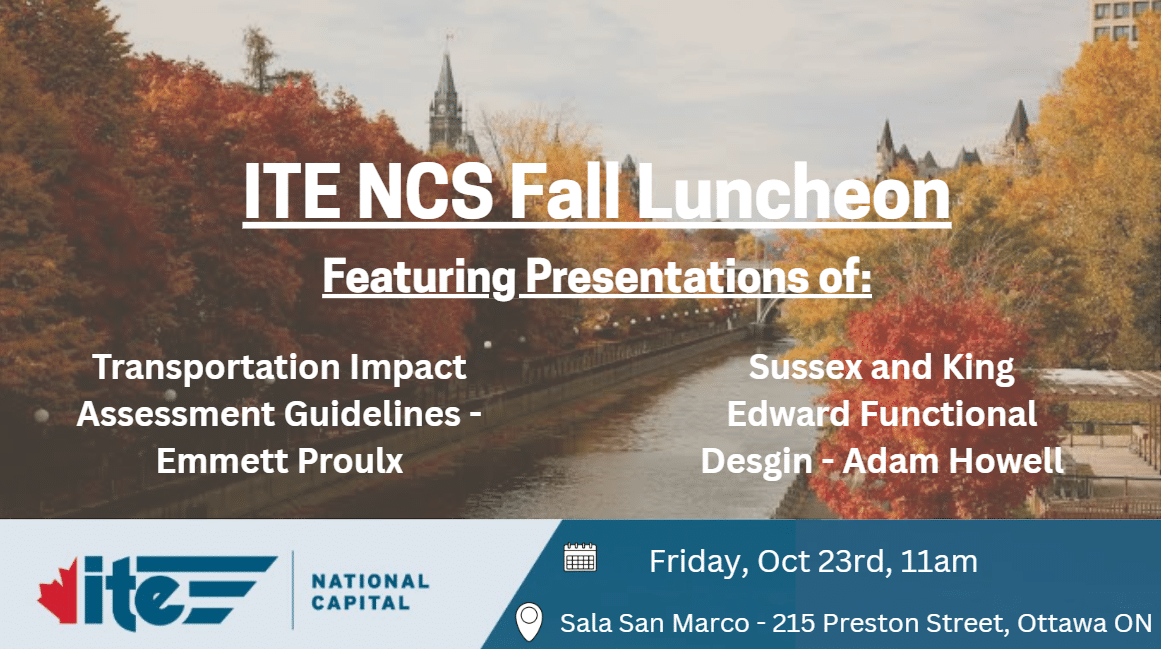
Join us for our Fall Luncheon on October 23 at 11 am for two amazing presentations regarding transportation work in our city.
DATE: Friday, October 23, 2026
TIME: 11:00 am – 1:30 pm
LOCATION: Sala San Marco, 215 Preston Street, Ottawa, ON
REGISTRATION: Ticket sales close Monday, October 19 at 11:30 pm
PRESENTATIONS
Transportation Impact Assessment Guidelines
Sussex and King Edward Functional Design – Balancing Priorities on Ottawa’s Confederation Boulevard
Sussex Drive forms part of the National Capital Region’s Confederation Boulevard Corridor, which connects the Ottawa and Gatineau Downtown areas and provides access to many of Canada’s important institutions in the National Capital Region. The intersection of Sussex Drive with King Edward Avenue in Ottawa represents a critical node for multimodal transportation, serving high volumes of vehicular, pedestrian, and cycling traffic, and providing access to key federal properties including the National Research Council, Global Affairs in the Lester B. Pearson Building, as well as an interprovincial connection to Quebec via the Macdonald-Cartier Bridge. This intersection has a history of operational and safety concerns; and was identified as a candidate for improvements in the City of Ottawa’s 2020 Cycling Safety Review of High-Volume Intersections Study.
The City of Ottawa, in collaboration with Robinson Consultants, undertook a functional design study to assess alternatives for potential improvements to the intersection. The project included the development of a number of operational and design alternatives including geometric and signal timing modifications integrating elements of the City of Ottawa’s protected intersection design guidelines. Specific challenges included maintaining vehicle capacity for a heavily used connection through the intersection and downstream weave towards the interprovincial MacDonald-Cartier Bridge to Gatineau, the limited width of the bridge on the southbound intersection approach over the Rideau River, maintaining access to adjacent government of Canada employment nodes, and coordination with ongoing construction at the adjacent Lester B. Pearson Building.
Development of the alternatives was based on a geometric and operational review, as well as the application of the City of Ottawa’s MMLOS Guidelines. The preferred design option is a protected intersection that incorporates bidirectional and unidirectional crossrides, smart-channel right turns with raised active transportation crossings, curb extensions thereby narrowing active transportation crossings, and concrete centreline hardening to reduce turning radii and vehicle speeds. The intersection concept was designed for future conversion of the westbound right turn from permissive to fully protected operation as warranted by future traffic volumes as well as a future bi-directional cycling facility on the west side of the roadway proposed by the National Capital Commission.
The presentation of this case study will outline the development and evaluation of the intersection design alternatives, responding to the unique geometric and capacity constraints and standards governing development in the area with having the ultimate goal of balancing the high-volume traffic movements with improved safety for pedestrians and cyclists through the application of the City of Ottawa’s new Protected Intersection Design Guidelines.
Adam Howell is a Senior Project Manager in Robinson Consultants’ Transportation Planning Team with more than 17 years of experience in transportation planning and traffic engineering assignments. Adam’s experience includes traffic analysis supporting large scale infrastructure projects including the Ottawa Confederation Line LRT and numerous MTO Bridge Structural rehabilitation projects along Highways 401, 416 and 417 in eastern Ontario, as well as traffic engineering and design for municipal road and intersection improvements and traffic impact studies for private developments.